Sunday, 30 December 2012

Virtually Anyone Can See The Dead Sea Scrolls Now

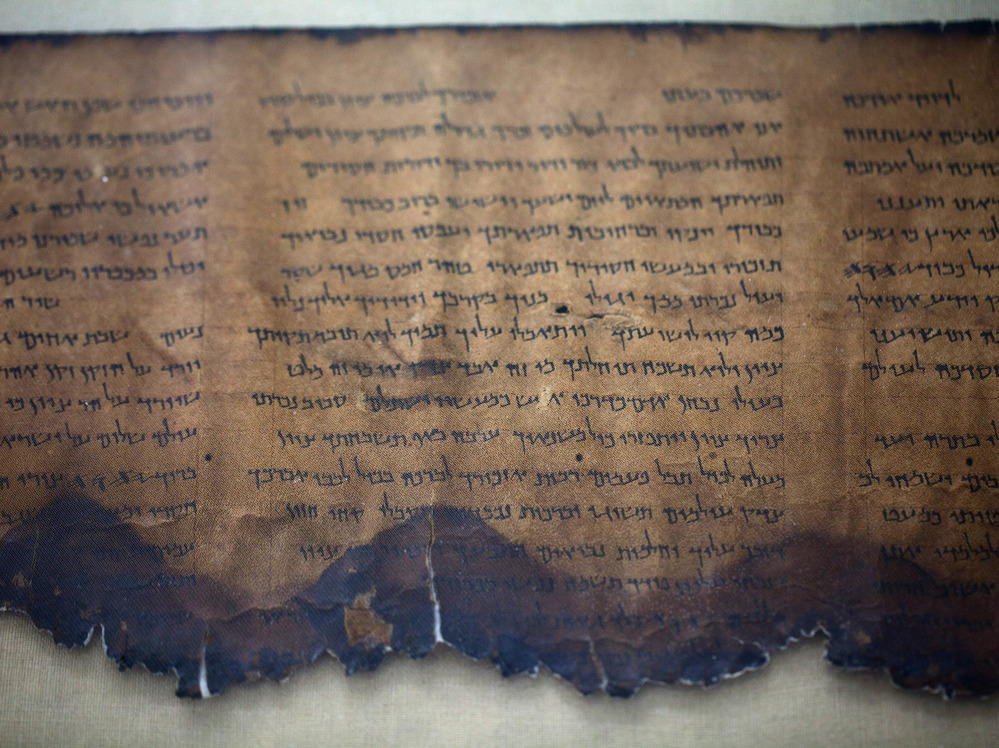
A fragment of the 2,000-year-old Dead Sea Scrolls is laid out at a laboratory in Jerusalem. More than 60 years after their discovery, 5,000 images of the ancient scrolls are now online.

Uriel Sinai/Getty Images A fragment of the 2,000-year-old Dead Sea Scrolls is laid out at a laboratory in Jerusalem. More than 60 years after their discovery, 5,000 images of the ancient scrolls are now online. A fragment of the 2,000-year-old Dead Sea Scrolls is laid out at a laboratory in Jerusalem. More than 60 years after their discovery, 5,000 images of the ancient scrolls are now online.
Uriel Sinai/Getty Images

This week, an ancient and largely inaccessible treasure was opened to everyone. Now, anyone with access to a computer can look at the oldest Bible known to humankind.

Thousands of high-resolution images of the Dead Sea Scrolls were posted online this week in a partnership between Google and the Israel Antiquities Authority. The online archive, dating back to the first century B.C., includes portions of the Ten Commandments and the Book of Genesis.

"Most of these fragments are not on display anywhere," says Risa Levitt Kohn, a professor of Hebrew Bible and Judaism at San Diego State University.

"In fact, even if you were to go to Israel, to the shrine of the book, you would not be able to see the 5,000 pieces that are online here," she tells Weekend Edition Saturday guest host Linda Wertheimer.

Some scrolls were already online — last year, Google and the Israel Museum collaborated to post five of them. This latest collection uses imaging techniques developed by NASA, allowing users to zoom in close enough to examine the texture of the skin the scrolls were written on.

Looking at an interactive image of the Book of Psalms, Kohn points out an example of a scribe's mistake — a letter written on top of a line of text.

"Parchment being very, very valuable, you couldn't scrap it and throw it in the trash," she says. "In the absence of a delete button, I guess you could say, they had to go write the additional letter that was missing. The only place they could actually do that is on the top of the line."

Over the years, Kohn has curated several Dead Sea Scrolls exhibitions. She says the Bible drives most people's interest in the scrolls.

"When it comes to Judaism and the early biblical period, this is really all we have in terms of ancient Hebrew texts," Kohn says. "This is really it, and I think that's incredibly powerful."


View the original article here

Dig Finds Evidence Of Another Bethlehem

The Israel Antiquities Authority says archeologists have found the oldest artifact that bears the inscription of Bethlehem, a 2,700-year-old clay seal with the name of Jesus' traditional birthplace.

The Israel Antiquities Authority says archeologists have found the oldest artifact that bears the inscription of Bethlehem, a 2,700-year-old clay seal with the name of Jesus' traditional birthplace.

AP

Thousands of Christian pilgrims streamed into Bethlehem Monday night to celebrate the birth of Jesus. It's the major event of the year in that West Bank town. But Israeli archaeologists now say there is strong evidence that Christ was born in a different Bethlehem, a small village in the Galilee.

About 100 miles north of where the pilgrims gathered, shepherds still guide their flocks through green unspoiled hills, and few give notice to the tucked-away village with the odd sounding name: Bethlehem of the Galilee. But archaeologists who have excavated there say there is ample evidence that this Bethlehem is the Bethlehem of Christ's birth.

"I think the genuine site of the nativity is here rather than in the other Bethlehem near Jerusalem," says Aviram Oshri, an archaeologist with the Israel Antiquities Authority which has excavated here extensively. He stands on the side of a road that now cuts through the entrance to the village. It was the construction of this road that led to the discovery of the first evidence that Bethlehem of the Galilee may have had a special place in history.

"It was inhabited by Jews. I know it was Jews because we found here remnants of an industry of stone vessels, and it was used only by Jews and only in the period of Jesus," Oshri says.

He also found artifacts which showed that a few centuries later the community had become Christians and had built a large and ornate church. He says there is significant evidence that in early Christianity this Bethlehem was celebrated as the birthplace of Christ. The emperor Justinian boasted of building a fortification wall around the village to protect it. The ruins of that wall, says Oshri, still circle parts of the Galilee village today.

He thinks many early scholars would have concluded that this Bethlehem was the birthplace of Christ.

"It makes much more sense that Mary rode on a donkey, while she was at the end of the pregnancy, from Nazareth to Bethlehem of Galilee which is only 7 kilometers rather then the other Bethlehem which is 150 kilometers," Oshri says.

He adds there is evidence the other Bethlehem in the West Bank, or what Israelis call Judea, was not even inhabited in the first century.

Paula Fredriksen, an American scholar of the historical Jesus, says that early Christianity only started to pay attention to the Judean Bethlehem in the fourth century, when the Emperor Constantine declared Christianity the official religion of the Roman Empire.

According to the Old Testament, Judean Bethlehem was the City of David where the future messiah would be born. Fredriksen says that it would make sense for early Christianity to focus on that Bethlehem

"The Bethlehem that's the only Bethlehem that matters for the tradition is David's Bethlehem," Fredriksen says. "And David's Bethlehem quite specifically is in Judea."

Oshri draws similar conclusions. He says that for devout Christians, the story of Jesus and his birth is inextricably linked to the internationally known city of Bethlehem.

How does Oshri think Christians would react to finding out that Bethlehem that they thought about is wrong?

"I don't think it will have any influence," he says. "The tradition is one thing. People will go on believing. And I can understand it."


View the original article here

In India, All Religions Join In 'The Big Day'

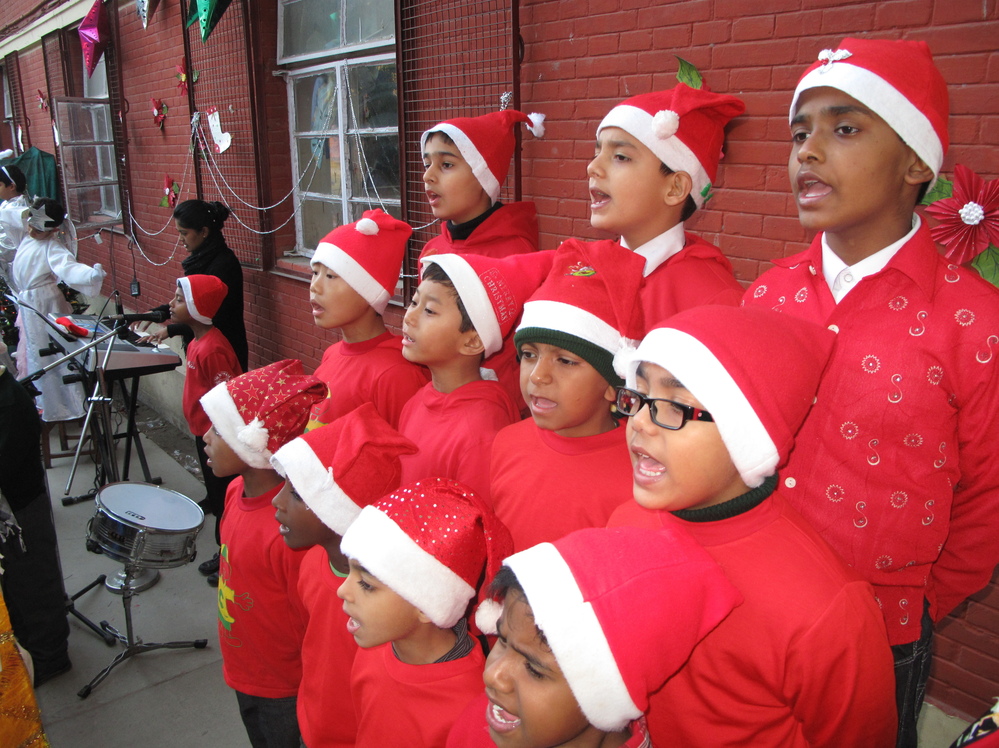
Carolers from St. Columba's School in New Delhi stage their annual Christmas program, where the student body is Catholic, Sikh and Hindu.

Julie McCarthy/NPR Carolers from St. Columba's School in New Delhi stage their annual Christmas program, where the student body is Catholic, Sikh and Hindu. Carolers from St. Columba's School in New Delhi stage their annual Christmas program, where the student body is Catholic, Sikh and Hindu.

Julie McCarthy/NPR

India, the birthplace of Hinduism, Buddhism and Sikhism, marks the birth of Jesus with a national holiday.

Indians call Christmas bara din, or the Big Day.

Chef Bhakshish Dean, a Punjabi Christian, traces the roots of Christianity in India through food.

Standing in the New Delhi kitchen of one of several restaurants he overseas, pots bubbling with scrumptious holiday specials, Dean says Syrian Christians were the first to arrive in India, in the first century. The ancient sect devoted to St. Thomas the Apostle is believed to have first landed on the Indian coast in what is today the state of Kerala. He says they came with the fabled spice trade, intermarried and introduced their cuisine.

Dean's Syrian stews, which top his Christmas menu, are infused with the scents of South Indian cloves, cardamom and star anise — a star-shaped spice with a hint of licorice that is popular in cooking throughout South Asia.

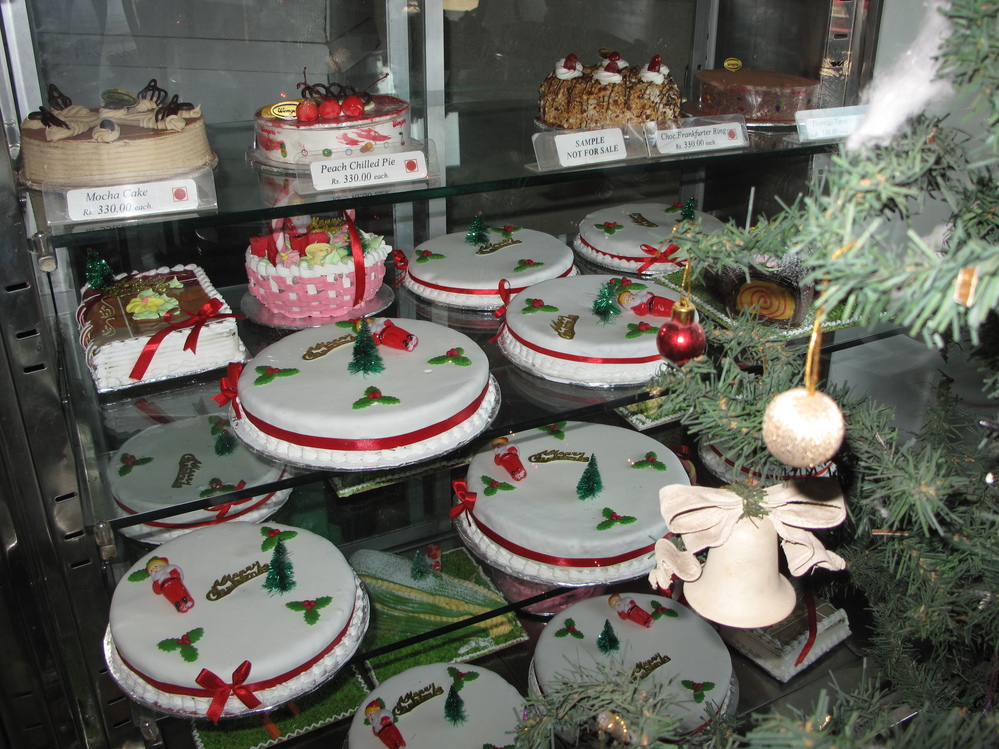
Christmas cakes filled the window at Wenger's, the fabled 86-year-old bakery in Delhi.

Julie McCarthy/NPR Christmas cakes filled the window at Wenger's, the fabled 86-year-old bakery in Delhi. Christmas cakes filled the window at Wenger's, the fabled 86-year-old bakery in Delhi.

Julie McCarthy/NPR

Just 2 percent of the Indian population is Christian, but writer Naresh Fernandes says, "That's 2 percent of the population of one billion. So that is quite a lot of people for whom December 25th is very important."

Fernandes says in his Roman Catholic neighborhood in Mumbai, the Portuguese converted the locals and Christmas tends to be "big opulent meals" that start in the afternoon and go late into the night. "Things like vindaloo, which is a preparation made of pork," he says, adding, "no roast turkeys, but lots of things involving fat and pig-lings."

The British Raj also may have fixed Christmas in the Indian imagination as quintessentially English: the requisite roasted turkey and tipple of mulled wine. They'll grace many Yuletide tables of Delhi's sizable expatriate community.

Delhi-based food writer Pamela Timms says she's managed to Indian-nize her traditional recipe for mince pies, which includes "glacee cherries."

"I found out this year they are not actually cherries in India," she says. "They are made from a local berry called karonda, which is pink and white in its natural state but once you add sugar to it and boil it away, it looks like a glacee cherry."

As a long-time resident of India, Timms says Christmas seems to slot right into the pantheon of festivals in the Indian calendar. "It's a time of year that comes right after lots of other Indian festivals, so the country is already in festival mode," she says.

Carolers from St. Columba's School in the capital stage their annual Christmas program that expresses the multifaith nature of India. This alma mater of health guru Deepak Chopra was founded by the Christian Brothers of Ireland, and while it is a Catholic school, the student body is also Sikh and Hindu.

Arsh Wahi, a Hindu student at St. Columba's, says his family puts up a Christmas tree every year and stocks up on plum pudding and other Christmas goodies from the fabled Dehli bakery called Wenger's.

With its 70 varieties of cakes in the shape of stars, yule logs and Santas, this 86-year-old establishment is jammed this time of year with holiday-makers who eat and sing their way through the season.

Choirs echo in the churches across the city, and choral groups perform Christmas concerts.

Neeraj Devraj, a soloist with The Capital City Minstrels, says he's not Christian or religious, but celebrates Christmas with the same fervor he celebrates the Hindu festival of lights known as Diwali, and the Muslim feast of Eid.

"For me personally, Christmas is about getting together with the people you are fond of, people you love," he says. "It's great fun, it's the joy of giving. It's very Indian ... to just celebrate the aspect of being alive and being around people who matter."


View the original article here

Thursday, 20 December 2012

Gospel Diva Vicki Yohe On 'Sounding Black'

Vicki Yohe has blond hair, blue eyes, and the look of a country-western singer. But she's an urban gospel music star and most of her fans are black. Yohe talks with host Michel Martin about race, music, faith, and her latest album, I'm at Peace: A Praise and Worship Experience.


View the original article here

Wine And Food May Rekindle Love Lost Between Russia And Georgia

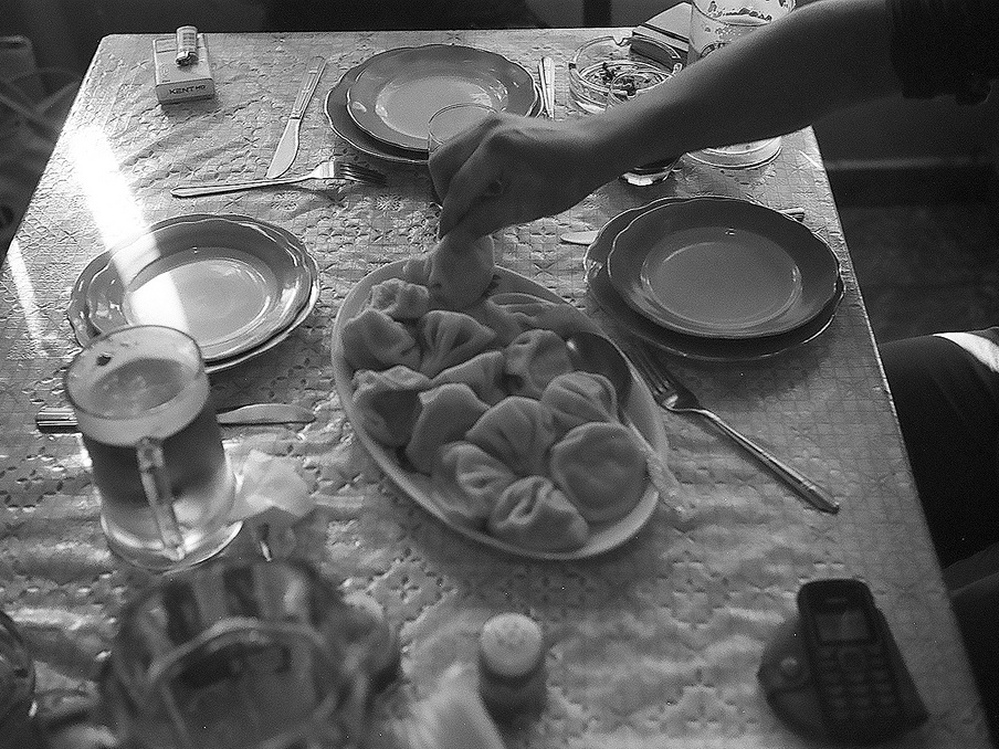
Eating lamb dumplings called khinkali at a table in Tbilisi, Georgia.

ostromentsky/Flickr.com Eating lamb dumplings called khinkali at a table in Tbilisi, Georgia. Eating lamb dumplings called khinkali at a table in Tbilisi, Georgia.

ostromentsky/Flickr.com

It's a big day in the religious and culinary calendar of the Republic of Georgia. Georgian Orthodox believers observe Dec. 17 as St. Barbara's Day, in honor of an early Christian martyr. And they typically mark the occasion by eating a type of stuffed bread called lobiani, baked with a filling of boiled beans with coriander and onions.

It's a tradition that's also observed at many restaurants in Russia, where Georgian food is the favorite foreign cuisine — fresher, spicier and more imaginative cooking than many Russians ever get at home. In fact, Georgian cookery is to Russia what Italian cuisine is to America — a national education of the taste buds, an illustration of the lesson that at the heart of the good life is good food.

The Russian love of Georgian food is made more poignant by the fact that the two countries have been at odds since before their brief 2008 war.

Georgian cuisine takes its inspiration from the country's geography, perched in the mountains at the eastern edge of the Black Sea, strongly original, but with elements of the Middle East, Central Asia and Eastern Europe.

Dinner at a typical Georgian restaurant starts with an array of appetizers that include khachapuri, a rich, cheese-filled bread that comes in all sorts of regional variations.

Have a side of veggies with that, such as Badrijani nigvzit, eggplant with ground walnuts, pomegranates seeds and juice, or ajapsandali, a spicy concoction of eggplant, potatoes, tomatoes and peppers.

If you go to a restaurant with Georgian friends, you'll be made to eat your way through salads, meaty soups such as kharcho, and salty cheeses called sulguni before you're even allowed to contemplate the entrees.

Then it's on to fish done 21 ways, or satsivi, which is chicken or turkey in a walnut sauce, or chakapuli lamb stew.

In case you've noticed that walnuts feature prominently in many Georgian recipes, you will have touched upon a tender point of Georgian pride.

Some Georgians in Russia claim that greedy Russian restaurant owners have ruined the flavor of the most popular Georgian dishes by substituting corn meal for ground walnuts. Now that would be like fobbing off canned spaghetti for the genuine al dente at an Italian restaurant in New Jersey.

At some point in your culinary odyssey, you'll get to the khinkali, dumpling purses filled with lamb and hot broth.

Khinkali dough is pinched together to form a stem, which you hold while nibbling a hole in the dumpling, through which you sip the juice before devouring the filling.

In Georgia, all this would be washed down with pitchers of wine, but here's where geopolitics have gotten in the way of gastronomy.

As a side effect of the bitter conflict between Russia and Georgia, imports of Georgian wine and mineral water are banned in Russia.

Georgian restaurants in Moscow make do with imports from France, Chile and Australia, but Georgian food lovers will tell you it's not the same.

Since October, when elections brought a new regime to power in Georgia, hopes have been raised that the wine ban might be lifted as a gesture of good will. Since most of Georgia's wine had been imported to Russia before the war, it may be a real economic gesture as well.

And just last week, diplomats from the two countries met in Switzerland for their first direct talks since the war.

Both Russians and Georgians have described their national relationship as something like a passionate love affair gone sour—maybe wine and walnuts can help restore the magic.


View the original article here

Spiritual Strength In Times Of Great Need

For nearly 30 years, Eugene Peterson served as the pastor for Christ our King Presbyterian Church near Baltimore. In the early 1990s, he began to translate the Bible into modern-day English. It became the best-selling book called The Message, a book millions of Christians and non-Christians have come to rely on. Host Guy Raz talks with Peterson about dealing with grief and moments of tragedy.

Copyright © 2012 National Public Radio. For personal, noncommercial use only. See Terms of Use. For other uses, prior permission required.

GUY RAZ, HOST:

Today and tomorrow, many people around the country will turn to their spiritual leaders for answers or at least for comfort. For nearly 30 years, Eugene Peterson served as the pastor for Christ Our King Presbyterian Church near Baltimore. In the early 1990s, he began to translate the Bible into modern-day English. It became the best-selling book called "The Message." It's a book millions of Christians and non-Christians have come to rely on.

Pastor Peterson has been a guest on this program in the past. And he was one of the first people we wanted to talk to after hearing the news from Newtown, Connecticut. And he's with me on the line now. And, Pastor Peterson, thank you for being with us.

REVEREND EUGENE PETERSON: I'm glad to be here.

RAZ: How do you retain your faith when you're faced with such a senseless tragedy?

PETERSON: Oh, I think about that; I think about that a lot. And everybody is just rocked by this disaster, tragedy in Connecticut. And one of the things that occurred to me as I was meditating, praying, thinking about this is the one good thing about this is that I feel like I'm so much part of a united community in America.

And I thought as I woke up this morning, Jesus' second Beatitude: Blessed are those who mourn for they shall be comforted. It doesn't mitigate the suffering, the mourning, the loss, but it does give witness that we live in a country with a president who knows how to mourn. That's what I've been thinking about this morning.

RAZ: How do you begin to cope with a kind of grief like this?

PETERSON: By not talking too much about it. Silence is sometimes the best thing to do, holding a hand, hugging somebody. There are no adages that explain or would make any difference to the suffering. Sometimes people say, I don't know what to say to these people. You know, I say don't say anything. Just hold their hand. Hold them, hug them and just stay around for an hour or so in silence and just be there. That's what we need at times like this, an affirmation of the sacredness of life, the holiness of life.

RAZ: I know that you gave thousands of sermons over your three decades as a pastor. And, of course, during times of crisis and in times of grief, what have you done in moments of grief? What has comforted you?

PETERSON: The presence of friends, mostly their silence, not talking too much. I remember when my mother died, and I had the funeral, and I broke down in the middle of this homily, of the Scripture reading. And I tried to contain myself, and I couldn't, and so I finally just cried. It didn't last long, maybe 20 seconds or 30 seconds. And when the service was over, I didn't want to talk to anybody. And I went into a little side room - it was not my own congregation - and sat. And my daughter came in and sat beside me. And she was about 25, 24 at the time.

And a man came in I didn't know. And he put his arm across my shoulders, and he started giving me cliches and talking God talk. And after a few minutes of that, he left. And I said to my daughter Karen: Oh, Karen, I hope I've never done that to anybody. And she said - she was so dear. She says: Oh, daddy, I don't think you'd ever do that. But I had done that. But you learn not to do that when you've been through this a few times.

RAZ: That's the pastor, scholar and poet Eugene Peterson. He's the author of "The Message." Pastor, thank you so much.

PETERSON: You're welcome. Thank you.

Copyright © 2012 National Public Radio. All rights reserved. No quotes from the materials contained herein may be used in any media without attribution to National Public Radio. This transcript is provided for personal, noncommercial use only, pursuant to our Terms of Use. Any other use requires NPR's prior permission. Visit our permissions page for further information.

NPR transcripts are created on a rush deadline by a contractor for NPR, and accuracy and availability may vary. This text may not be in its final form and may be updated or revised in the future. Please be aware that the authoritative record of NPR's programming is the audio.


View the original article here

Mormon Women Dare To Wear Pants To Church

There may be fewer skirts sighted outside Mormon churches in Salt Lake City this Sunday.

There may be fewer skirts sighted outside Mormon churches in Salt Lake City this Sunday.

George Frey/Getty Images

Sunday morning could see a pants revolution at church, at least if you're Mormon. A group of women in The Church of Jesus Christ of Latter-day Saints is inviting all sisters to shed their skirts and dresses, and wear slacks or pantsuits in an attempt to change the conservative dress code.

Worship services in the LDS church aren't formal; "Sunday Best" hasn't meant gloves, hats and tights for decades. These days in most American congregations, the women wear skirts and the men wear ties. Stephanie Lauritzen discovered that pants on women can still raise eyebrows at her congregation in Utah.

"People were afraid to talk to me. People who would never hesitate to talk to me in a skirt and heels were suddenly reluctant to talk to me wearing pants," she says.

A little fed up with the ossified gender roles this represented, Lauritzen created an event on Facebook, called it "Wear Pants to Church Day," and started inviting her friends. Thousands of people all over the country have signed up. Others commented that it was a bad idea. Lauritzen points out that Mormon church leaders haven't actually taken a position on pants.

"You think we'd have won that battle — we have won that battle. Now we're just fighting a cultural norm," she says.

It's a cultural norm that has gotten harder to pin down as American attire gets more and more casual. A few people in the pews on any given Sunday look like they're stopping in for a prayer on the way to a football game. Mormon women — and women in general — see few modest style icons.

"I think people like, say, Kate Middleton, who maintain a conservative nature while wearing fashionable clothes that look good on them," says Michaela Carey, an economics researcher in Chicago. She's not wearing pants to church this Sunday. Not because the duchess of Cambridge isn't often seen in pants, but because she feels like this movement won't do much to advance the conversation about gender equality.

Mercedes White, Carey's sister-in-law in Salt Lake City, feels differently. "It's not official. It is happening informally, that women are being told what to wear," she says. "And I think that needs to be pushed back against."

White says she wears pants to church with some frequency. She thinks they're more stylish, comfortable and practical than skirts, especially in the Salt Lake winter.

Rebecca Van Uitert, a lawyer in Chicago and a leader in her congregation, will wear slacks Sunday, to help other women feel welcome however they dress. "I'm kind of neutral about what people wear to church. I'm just happy when people are there," Van Uitert says.

Her sentiment is familiar to clergy across many other faiths: Whatever you decide to put on, for heaven's sake, just come to church.


View the original article here